In the sciences, we all know that lab is an experiential activity that allows our students to learn by doing. This idea is kinesthetic learning – moving one’s body while learning. While participating in a kinesthetic activity, students are out of their seats and moving about the room. They are manipulating equipment and chemicals to conduct their lab experiment. The concepts in lab reinforce the concepts from the lecture. No one teaching science would disagree that lab is an essential portion of teaching and learning science. But why is that? What research supports this idea? And how can you include additional sorts of kinesthetic learning in your classroom?

The benefits of kinesthetic learning
There are plenty of ideas as to how the inclusion of kinesthetic activities improves learning.
Active engagement – when the student is doing rather than just listening, they are by default more engaged and more awake as they move their body.
Muscle memory – if the skills being mastered are physical, there is a benefit to going through the motions of the skills many, many times. The motions and their sequence start to become automatic. This concept applies well to athletic skills, playing an instrument, using tools, etc.

Feedback loop – when practicing a skill through a kinesthetic activity, there is generally immediate feedback that tells the student when they went astray. For instance, a sour note from their musical instrument, spills from the chemicals meant to go into the graduated cylinder, the ball missing the goal. They know right away if their physical movements are leading to success or not.
Multi-sensory learning – when a student is reviewing their notes they are using their eyes. When listening to your lecture they are using their ears. If they are working problems with a nearby partner and talking about it, they are using their eyes, ears, and voice. But if you add getting out of their seat, or an activity that requires manual dexterity, they are involving nearly all their senses at once. The brain processes all these sensory signals and associates them together. The connections for more quickly and are stronger.
If you’re reading this and thinking, “I want an engaging classroom, but I have no clue where to start,” I’ve got your back. My free Engaged Chemistry Classroom Blueprint lays out the high-impact shifts that make student engagement feel doable, even when you’re exhausted.
Evidence of the Efficacy of Kinesthetic Learning
Why Kinesthetic Learning? – National Math Foundation cites multiple studies on school-aged children and the impact of including kinesthetic learning on achievement test scores.
The effects of incorporating kinesthetic learning on learning outcomes and on-task behavior outcomes and on-task behavior – Katherine Sauro SUNY Cortland reports the results of a carefully conducted study showing improved academic performance, more time on task, and increased positive perceptions of students when kinesthetic learning is included.
An Argument for kinesthetic learning in classrooms – Beaumont Enterprise describes how hands-on activities and kinesthetic activities more closely resemble problems that students will face in the real world, vs the artificially controlled environment at school.
As a chemistry teacher, I have known forever that lab is often where the concept finally clicks. I have watched students diligently try to follow along with concepts in class, but you can tell that they don’t quite grasp how things all fit together. Once they conduct an experiment themselves, they see the concept in action from their hands. Then I watch their expression change as they suddenly understand at a very different level.
In some ways, it would be great to have lab every day. Every lesson could be kinesthetic. No one would sit down and listen to you explain a concept detached from experience ever again. Except the prep work to get materials ready every day. And the messes to clean up every day. And the cost of materials and equipment used every day. Wait…. I am exhausted now!
Try a kinesthetic activity without the costs of lab
Having experiential learning every day like labs is too daunting to think about. And old-fashioned lecture while the kids sit still is not good for anyone either. The best of both worlds? Kinesthetic activities that involve manipulatives and hands-on puzzles. In this way, they may not be wandering the room, but they are moving their hands and using manual dexterity to fit together objects in three dimensions.
Examples of such ‘at your desk’ hands-on puzzle activities include these hexagonal tarsia. The student has a pile of hexagonal tiles with the name or formula of an ionic compound on each edge. The pieces fit together to form an overall shape with a matching pair at every intersection point. The student is practicing nomenclature and strengthening that skill, while problem solving, and working in 3 dimensions with their hands. If they are working on this puzzle with a partner, even more senses and brain areas are engaged.
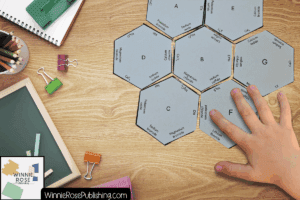
How about a card game that practices chemistry skills? On each card is a neutral atom or a single atom ion. A pair of students can play a game similar to the old-fashioned card game ‘war’, but the winner is determined by the largest sized atom. Or the winner is the atom with the highest electronegativity, or maybe the highest first ionization energy. With this activity, the various periodic trends are reviewed. When there is a debate about the winner, the students need to consult their notes and charts to make a decision.
More examples of kinesthetic activities to try
Another option for a kinesthetic activity that keeps the students’ hands occupied is card sorting where the cards are arranged to make a concept map of the content in a unit. As they arrange the cards to show relationships between concepts, they are explaining to their partner why their choice makes sense.
A classic activity is using toothpicks and mini marshmallows to build models of the various VSEPR shapes of covalent molecules. Building a three-dimensional structure in their hands helps a student translate the two-dimensional image on the page into something they can turn. They can view it from every angle and truly grasp what the two-dimensional picture is conveying. If you provide a protractor, they can measure angles to prove to themselves what results when you attempt to distribute 3, 4, or 5 groups of electrons around a central atom.
For years, I have used an activity that uses uncooked pasta noodles as a model system for stoichiometry and definite proportions in a molecule. They can see quickly how product formation abruptly stops when a particular pasta shape runs out, and no more ‘molecules’ can be created.

Including the kinesthetic activity in the lesson plan
If your schedule of classroom activities is fairly packed, you may worry about how to fit in some kinesthetic activities. The things described above do not take a whole class period and can be scheduled along with other things on that day. Don’t try to shove in the new activity without getting rid of something. I am sure you can identify an activity or a worksheet or video that is not performing as well as you would like. Replacing that item with something new does not need to be overwhelming or daunting. Try one or two new activities at a time and see how it goes. Everything listed above is low prep and almost no cost.
Every time I feel like a topic is not getting across as well as it used to, I change out what seems to be the most passive activity from that unit and try out a kinesthetic activity. It has always turned out to be a welcome change of pace for everyone. And I have never noticed learning to be negatively impacted by my choice. What have you got to lose?
Need some activities that include all real-world examples? Check out this recent post or this post about using oatmeal cookies as a basis for teaching about moles and Avogadro’s number. When I brought in a hands-on hook at the start of a lesson, just something simple like tasks cards or a mystery challenge, it completely changed how my students paid attention. If you’re ready to try stuff like that more consistently, download the Engaged Chemistry Classroom Blueprint. It’s free and full of ideas you can build on, your way.