
What are task cards? Aren’t those used in middle school? I use chemistry task cards in my high school classroom. Let me tell you why, and how you can use them in your chemistry classroom too. Students love it and you will too.

Sometimes you need a low prep (or no prep… let’s be honest) option to get students to practice material. You have an old worksheet with dozens of examples, but you are less than inspired to use that again. You are tired and need a fresh idea and the inspiration and time to develop something.
Task cards to the rescue! A set of task cards covers one topic or skill. There are at least 12 cards with different examples on them. You distribute the cards around the room. Students get out of their seats and wander around answering the questions.
If you’re reading this and thinking, “I want an engaging classroom, but I have no clue where to start,” I’ve got your back. My free Engaged Chemistry Classroom Blueprint lays out the high-impact shifts that make student engagement feel doable, even when you’re exhausted.
How to use task cards in the classroom
As to how many questions you expect a student to answer, there are many options for using task cards in the classroom. Have some kids do the even-numbered cards, vs other kids do the odd-numbered ones. Have them draw a ticket from a hat with a random set of card numbers they should do. Set it up as a race between groups of students doing a set number of cards. Set it up as an escape room situation where they cannot get access to the next card until they successfully complete the first card. If you have the time, have the students do the whole set.
It is also possible to give the students the illusion of choice, while still ensuring that each student does a variety of the various of types of problems. In a set of 24 cards, I will often say to students that they must do at least 3 cards from the first half of the set (the simpler problems) and at least 3 cards from the second half of the set (the harder problems) and then 2 more cards of their choice. In this way, I am sure that they have done a distribution of difficulty while still giving the students agency to make choices for themselves. Use your imagination and the cards can be used however you like.
Chemistry Task Card Examples
Now, you are thinking, what topics work well with task cards? Here is a list of chemistry task cards I have used in my classroom (high school honors chemistry).
- Ionic nomenclature
- Electron configuration
- Calculating molar mass
- Acid-base conjugate pairs
- Classifying reactions
- Calculating solution concentrations
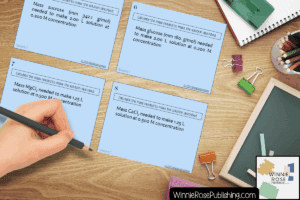
Any topic that requires practice and can be done on a quarter page of space lends itself really well to task cards. If you have an old worksheet that you are tired of using, you can pop the individual questions onto quarter sheets of paper and distribute them around the room. The advantage is not in the problems being different from what you were doing before. The advantage is that the kids are out of their seats and have some choice as to what problems they are working on.
Incorporate Real-World Examples on Task Cards
While most task cards are the same types of problems that you would find on a classic practice worksheet, there is an opportunity to have real-world examples on the cards. Why do solution calculations need to be only on random examples like ‘find the molarity of 14.5 grams of NaCl dissolved in a solution of 200 mL?’ Why can’t the card give information about the salt concentration in a saline IV bag and calculate that? Or the molarity of sodium hydroxide in drain cleaner? Or the percent composition of each element in caffeine molecules? They can. Click here for a recent post describing the advantages of real-world examples in your chemistry lessons and how to include them.
In my experience, students need to move around the room sometimes. Sitting still for 7 hours (even for a high schooler) is hard. Task cards distributed throughout your room allow the kids to get the ‘wiggles’ out and have a break in between their other classes that may focus more on seat time. Depending on how I assign which cards to do, they will end up working with students they generally do not interact with. I watch them help each other and work through the problems. They like the challenge of getting the cards done at various stations and the freedom to accomplish the goals in whatever order they wish.
Task cards are more commonly used with younger students, but no one in my class has ever suggested that they think working on the cards is childish or silly. They seem to really enjoy it.
Including Variety and Choice in the Task Card Activity
Now what about grading their work? If all the kids are doing a random selection of cards, how do you grade their work? A good set of task cards comes with an answer key that shows an answer and a worked solution for every card. As long as the students indicate which cards they have done, it should be fine.
The task card sets linked above all have a student answer sheet that has room for the full set, as well as quarter-page answer slips that give room for the student to show their work. This works well when you are assigning a subset of the cards. I print a double-sided page with 8 quarter-page answer slips on it for students to show work on 8 examples. If the task cards have more complicated problems like solution calculations or stoichiometry, they will be unlikely to finish more than 8 cards in a period. If the topic is easier, like nomenclature, they can do a larger portion of the whole set in the period.
Task Card Ideas
Plenty of teachers have successfully used task cards in their high school science classes. Below are some articles that describe that.
Task Cards – 15 ways to increase classroom engagement – by Getting Nerdy With Mel And Gerdy.
Task Cards – the surefire way to spark curiosity in science by the Teachers Upstairs
Why Play Games with Task Cards? By Team Tom Education
I often use task cards as an in-class formative grade, where the focus is practicing problems. You can use them as a game, as a test review, or as an enrichment for early finishers. Some people use the cards as bell ringer assignments. Others use the cards as exit tickets.
Besides their versatility, a great feature of task cards is that there is almost no prep. You need to print the cards (and maybe laminate them) one time, and they can be used for years. You just need new answer sheets for students each semester. There is no added equipment to find. No consumables to purchase. No fuss.
Differentiation
Whether or not you are a fan of the theory of different learning styles, there is no doubt that differentiation is still a goal. You need a long list of methodologies available to teach with from day to day. Some days are best structured as group instruction, while others are clearly lab days. Other topics are great with a guided inquiry activity. With task cards as an option in your list of pedagogical strategies, the students who learn better while moving around benefit. Students work together helping each other with the problems. As the teacher, I can work with individual students who need help getting started as they figure out what to do.
If you have never used task cards before in your chemistry classroom, they are a low-tech, low-prep, low-risk option to try. Give these examples a try. You won’t regret it. When I brought in a hands-on hook at the start of a lesson, just something simple like tasks cards or a mystery challenge, it completely changed how my students paid attention. If you’re ready to try stuff like that more consistently, download the Engaged Chemistry Classroom Blueprint. It’s free and full of ideas you can build on, your way.